







The photographers who book steadily rarely do ten things at once. They make it easy for the right client to find them, trust them and pay them, and then they keep in touch. That points to one asset that sits under every other tactic: a website you control, with a portfolio that shows the work you want to be booked for, galleries that clients enjoy using, and a shop where prints and downloads can be bought without you chasing anyone.
This guide builds the plan in the order a working photographer needs it: website, local search, email, referrals, social content, then the gallery and print sales that turn attention into income. It ends with a simple way to tell what is working.
TL;DR
- Start with your own website: a clear portfolio, an About page, services, testimonials and an easy way to enquire, as The Society of Photographers recommends.
- Set up a free Google Business Profile and collect reviews, because many clients begin with a search for a photographer near them.
- Build an email list and a referral habit: these cost little and bring back the people who already trust you.
- Use private client galleries, proofing and a print and download shop so every shoot can lead to more sales.
- Track a handful of numbers (enquiries, bookings, average order value) and drop what does not bring work.
Table of Contents
- Decide what marketing is for
- Name your ideal client
- Build the website that does the selling
- Get found locally
- Build an email list you own
- Make referrals a habit
- Use social media where your clients are
- Turn galleries into a sales tool
- Price so that marketing pays for itself
- Measure what brings work
- Where ShutterPress fits
- A simple 90-day plan
- FAQ
- Sources
Decide what marketing is for
Before choosing tactics, choose the goal. The Professional Photographers of America (PPA) says marketing success depends on preparing, setting goals and measuring results, starting with whether you want more clients, a higher average sale per client, or more attention on a particular product or service.
Those are three different jobs:
- More clients: you need visibility, so local search, referrals and a portfolio that matches the work you want.
- A higher average sale: you need better products and a better buying experience after the shoot, such as galleries with prints and albums on offer.
- Promote one service: mini sessions, a seasonal offer or a new product, usually announced by email and social posts.
Write down one goal per quarter. A wedding photographer wanting fewer, higher-value bookings will market differently from an event photographer who wants every attendee to buy a photo.
Name your ideal client
The Society of Photographers puts defining your ideal client near the start of its list. It matters because every later choice depends on it: the images on your homepage, the words on your services page, the platforms you post on, even the local businesses you approach.
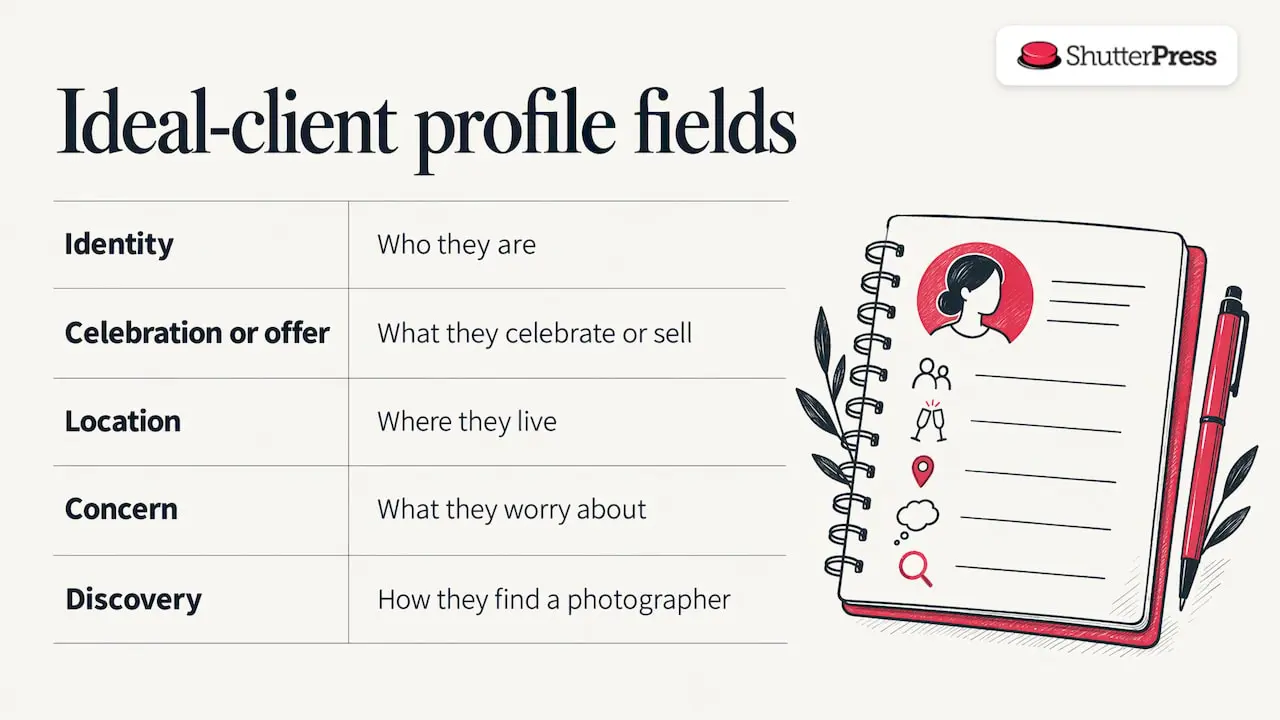
A useful description is short and concrete: who they are, what they are celebrating or selling, where they live, what they worry about, and how they usually find a photographer. “Families within 20 miles who want relaxed outdoor portraits” gives you something to act on. “Anyone who likes photos” does not.
Build the website that does the selling
Your website is the one place you fully control. Constant Contact describes it as your best salesperson while you are behind the camera, showing your style, packages and booking process in your own words.
According to The Society of Photographers, a photography website should include:
- a clear portfolio that reflects the work you want to be booked for
- an informative About page
- service details
- testimonials
- a simple contact process and clear calls to action
- fast loading times and a mobile-friendly design
Two points deserve emphasis. First, show only the type of work you want more of. If your portfolio mixes weddings, pets, product shots and corporate headshots, nobody can tell which one you are best at. Second, fast loading matters for photographers more than most, because image-heavy pages are the ones that get slow.
If you run your site on WordPress, the gallery layer is where presentation is won or lost. ShutterPress offers grid, masonry and justified layouts, reusable templates, and lightbox and display effects, so a portfolio can look considered without custom design work. You can see the layouts on the demo galleries and the template examples. If you are starting from nothing, our guide to creating a photography website with WordPress walks through the setup.
Get found locally
Most local bookings begin with a search. Constant Contact notes that clients typically start on Google with queries such as “family photographer near me”, and that a free Google Business Profile puts you on Google Maps and Search with photos, hours and reviews. It says this can be optimised in an afternoon.
A practical routine:
- Claim and complete your Google Business Profile: services, service area, opening hours, your best images.
- Ask every happy client for a review while the experience is fresh, and send them the direct link.
- Put the places you serve and the type of work you do into your website text, on the pages where they naturally belong, so the site and the profile say the same thing.
- Reply to every review, short and human.
The Society of Photographers also lists local SEO (search engine optimisation, meaning making your site easier for search engines to match to local searches) and collecting reviews among its core steps. None of this is glamorous, but it works while you sleep.
Build an email list you own
Social platforms change what they show. Email is different: Constant Contact calls it the one audience you own, reaching inboxes without fighting an algorithm.
People rarely sign up for “updates”. The Society of Photographers suggests offering a genuine incentive, such as a planning guide, a checklist or location recommendations. A family photographer might offer “What to wear for your portrait session”. A wedding photographer might offer a timeline checklist for the day.
Once people are on the list, Constant Contact suggests using email to:
- announce mini sessions and seasonal offers
- share recent work and preparation tips
- remind past clients to rebook or order prints
That last one is underused. A client who loved their session in spring may well want a print or an album by December, and a short reminder with a link to their gallery is often all it takes.
Make referrals a habit
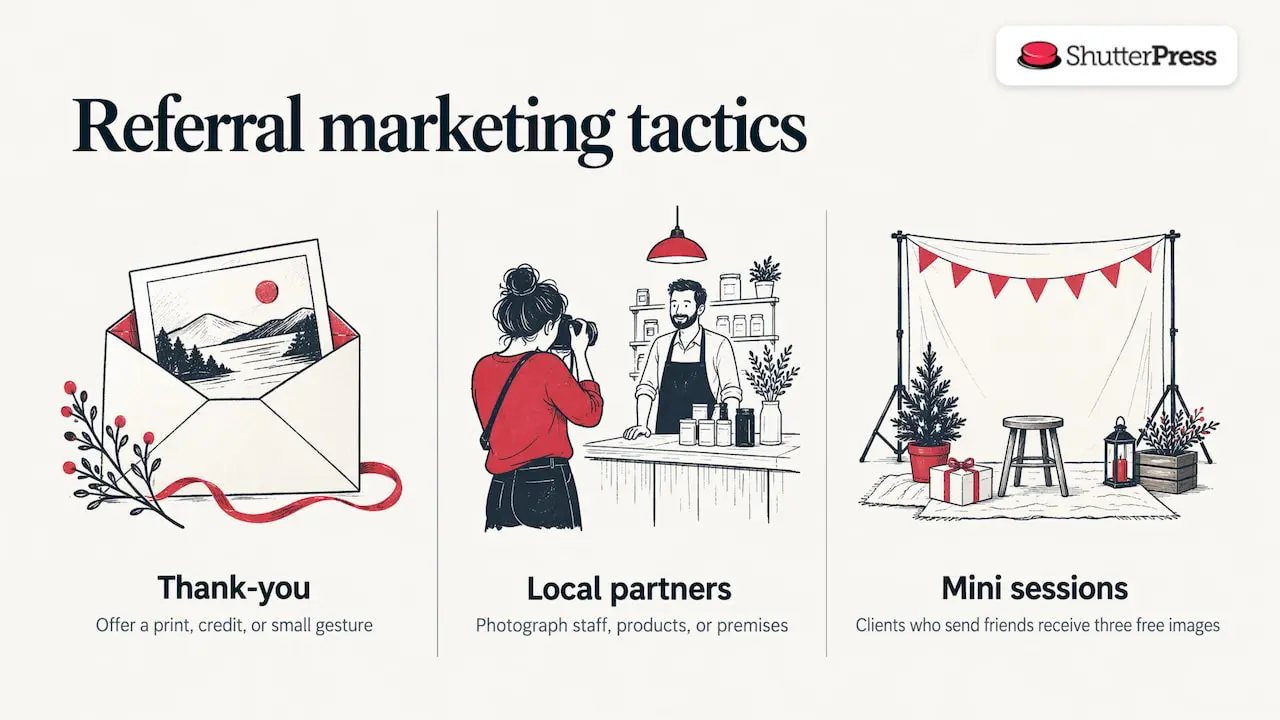
Happy clients are your cheapest marketing, but they rarely refer anyone unprompted. The Society of Photographers recommends a deliberate referral strategy, where a personal thank-you, a print, a credit or another small gesture encourages clients to recommend you, and says it need not be a large discount. It also recommends staying in touch with past clients and collaborating with complementary businesses.
For a UK photographer, complementary businesses are close to home: wedding venues, florists, planners, schools, nurseries, estate agents, local shops and cafés. Offer to photograph their staff, products or premises, and ask them to mention you in return. WHCC makes a similar suggestion for print sales, networking with local businesses by photographing their services or staff.
PPA suggests a more active route for portrait photographers: themed events and mini sessions, such as a seasonal setting with props, where clients who send friends receive three free images. It is a US source, so adapt the format to your own season and venue, but the principle travels well: a short, themed, limited-time offer is easy to explain and easy to share.
Use social media where your clients are
You do not need every platform. The Society of Photographers advises choosing the platforms where your target clients actually spend time, then mixing finished photographs with behind-the-scenes content, short videos, tips, client stories and answers to common questions. It stresses engaging with people rather than broadcasting.
Constant Contact adds that short video travels further than a single photo: behind-the-scenes clips, before-and-after edits and session teasers all work.
A realistic weekly rhythm for one person:
- one finished image or small set from a recent shoot
- one short video from behind the scenes or an edit
- one answer to a question clients ask you, such as “How long until I get my photos?”
- ten minutes replying to comments and messages
Every post should point somewhere you own: your website, your enquiry form or a gallery. Social attention you cannot convert is just attention.
Turn galleries into a sales tool
This is where many photographers leave money behind. The shoot is done, the client is happy, and the photos are sent as a download link or a folder. A gallery on your own site changes that.
WHCC points out that online galleries let clients, their family and friends buy images directly from you, which is especially valuable for landscape, destination and wedding photographers when in-person sales are not possible. For an event photographer, the same logic applies to guests who were never part of the booking.
Private galleries and proofing
A password-protected client gallery does three jobs: it delivers the work professionally, it lets the client choose their favourites, and it gives you a natural moment to offer prints, albums or extra files. ShutterPress supports password-protected client galleries, proofing and favourites, so clients can review and pick within the gallery itself. Our proofing feature page explains how it works, and the client photo gallery guide shows how to set one up on WordPress.
Event photographers gain the most here: one gallery, a shared password, and every guest able to browse and mark the photos they like.
Selling prints and downloads
ShutterPress connects to WooCommerce, the most widely used WordPress shop plugin, so prints and digital downloads can be sold from the same galleries. For photographers with large collections, the practical benefit is that template products mean you do not need a separate WooCommerce product for every photo. That is the difference between a shop you can maintain and one you abandon after the first wedding.
WHCC’s advice for turning viewers into buyers is to pair the gallery with:
- education about the print products you offer
- client reviews on your website
- an email list
- care for existing relationships
For artists selling prints, Fstoppers summarises a photographer’s findings that local scenes sell better locally, that bright, colourful prints generally outsell darker, moodier ones, and that buyers prefer horizontal images because they fill more wall space. These are one photographer’s observations rather than a law, but they are a sensible starting point when deciding which images to put first in your shop.
Our guides on building a photography print store and selling photos with WooCommerce cover the setup in detail.
Price so that marketing pays for itself
Marketing that brings in enquiries at prices too low to cover your costs just creates busy work. Before you spend on promotion, know what each hour and each shoot has to earn. Our cost of doing business calculator helps you work that out, and the guide on pricing your photography services shows how to turn the number into packages.
Once you know your numbers, a print or a download add-on in the gallery becomes a deliberate way to raise the average sale rather than an afterthought.
Measure what brings work
PPA’s advice is to measure results against the goal you set. You do not need a complex dashboard. Keep a simple monthly note of:
- Website visits, to see whether attention is growing
- Enquiries, to see whether the portfolio and calls to action work
- Bookings, the share of enquiries that became paying clients
- Average order value, including print and download sales
- Repeat clients, to see whether your email and referral habits are paying off
Add one question to your enquiry form: “How did you hear about me?” It costs nothing and tells you whether to spend more time on Google, referrals, Instagram or something else. If enquiries are low, look at the portfolio and local search. If enquiries are healthy but bookings are low, look at your response time, your pricing and how you present packages.
Review the numbers each quarter and drop the one channel that brings the least. Doing fewer things properly beats doing everything half-heartedly.
Where ShutterPress fits
If your site runs on WordPress, ShutterPress is built for the part of this plan that happens after someone lands on your site: showing the portfolio in customisable grid, masonry or justified layouts, delivering private client galleries with proofing and favourites, and selling prints and digital downloads through WooCommerce. It is available as ShutterPress Gallery Pro on an annual subscription licence, and there is a free option too.
You can look through the full feature list, see the free version, or read how to try ShutterPress Gallery Pro for free. When you are ready, ShutterPress Gallery Pro is where the paid plan lives, and the installation and settings documentation takes you through setup.
A simple 90-day plan
If this feels like a lot, sequence it:
- Month one, foundations: tidy the portfolio so it shows only the work you want more of, complete your Google Business Profile, and add an enquiry form with the “How did you hear about me?” question.
- Month two, relationships: write your email incentive, start the list, ask past clients for reviews, and contact three local businesses you could work with.
- Month three, sales: set up private galleries with proofing for your next shoot, add prints or downloads to them, and send a reminder email to past clients.
Then review the numbers and choose what to repeat.
FAQ
How do I market a photography business with no budget?
Start with the free tools: a Google Business Profile, reviews from past clients, an email list and a website that shows your best work clearly. Referrals cost little too: a thank-you note or a print is enough. Time is your main spend, so choose one or two channels and do them consistently.
Which social media platform is best for photographers?
The one where your ideal clients already spend time. The Society of Photographers advises against maintaining every account. Pick one platform, post a mix of finished photographs, behind-the-scenes content and short videos, and send people back to your website.
Do I need a website if I already have social media?
Yes. A website is the one place you fully control, and it is where clients see your portfolio, services and booking process in your own words. It is also where you can run private galleries and sell prints, which a social profile cannot do in the same way.
How can I sell more prints after a shoot?
Deliver the photos in an online gallery that lets clients, family and friends buy directly, and tell clients about your print products before the shoot as well as after. Reminder emails to past clients help too. With ShutterPress, prints and downloads can be sold through WooCommerce from the gallery itself.
How do I know which marketing is working?
Track enquiries, bookings and average order value, and ask every enquirer how they found you. Compare the answers each quarter and put more effort into the channels that bring paying clients.
Sources
- Marketing for Photographers: 21 Proven Ways to Grow Your Photography Business, The Society of Photographers
- Marketing 101 for Photographers: Reach More Clients, PPA
- Finding New Photography Clients: 7 Tips, PPA
- Photography Marketing: Simple Strategies to Book More Clients, Constant Contact
- Effective Strategies for Selling Professional Prints, WHCC
- Practical Truths About Selling Photography Prints, Fstoppers



Add your first comment to this post